
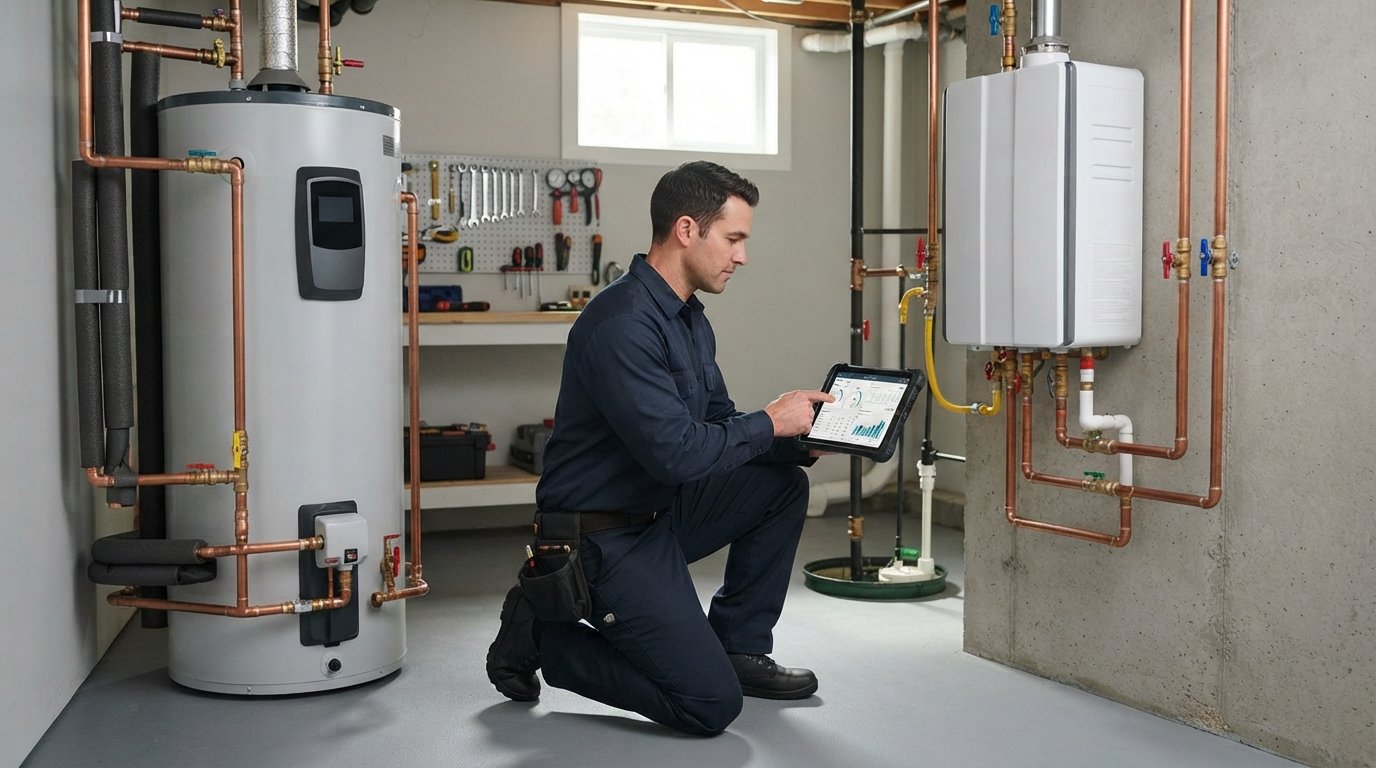
Heat Pump Water Heater vs Tankless: Which Saves More?
Compare heat pump vs tankless water heaters to see which saves more on energy bills. Call (833)-700-4293 for expert help finding a local pro.

Learn more about Water Heater Repair or Maintenance for guides, costs, and what to expect.
Compare Water Heater Repair or Maintenance Pros Near You

Enter your ZIP code to compare top-rated local professionals and request free quotes.
Replacing a water heater is one of those home decisions that feels urgent the moment your old unit starts leaking or sputtering. You want hot showers back fast, but you also want to stop overpaying on energy bills. The two most talked-about upgrades are heat pump water heaters and tankless units, and the debate often comes down to one question: heat pump water heater vs tankless, which saves more? The short answer is that it depends on your climate, your household size, and how you define savings. The longer answer, which this guide unpacks, involves upfront costs, installation quirks, rebates, and maintenance routines that protect your investment over a decade or more.
We will walk through how each system works, where each one shines, and how to run the numbers for your own home. Along the way, you will see that the cheapest sticker price rarely tells the full story. By the end, you should have a clear framework for choosing between a heat pump water heater and a tankless model, plus a practical sense of what installation really involves.
How Heat Pump and Tankless Water Heaters Work
A heat pump water heater looks like a conventional tank unit, but it moves heat instead of generating it. It pulls warmth from the surrounding air and transfers it to the water in the tank. Because it moves heat rather than creating it through resistance coils, it can be two to three times more efficient than a standard electric tank. That efficiency comes with caveats: it needs a steady supply of ambient air, it produces cool, dry exhaust air, and it works best in spaces that stay between roughly 40 and 90 degrees Fahrenheit.
A tankless water heater, by contrast, heats water on demand as it flows through a heat exchanger. There is no storage tank, so you never pay to keep a full tank hot while you sleep or work. Gas tankless units can deliver an endless supply of hot water if they are sized correctly, while electric tankless models often struggle to run multiple fixtures at once. The efficiency story here is about eliminating standby losses, not about moving heat. For a deeper look at how heat pump technology stacks up against other heating systems, our comparison of heat pump vs furnace cost and efficiency offers useful context on how heat pumps perform in real homes.
Understanding these mechanical differences matters because they drive everything else: installation requirements, climate sensitivity, maintenance needs, and the actual savings you can expect. A heat pump water heater is essentially a refrigerator running in reverse, while a tankless unit is a high-powered on-demand heater. Neither is universally better, but one will almost certainly fit your household better than the other.
Energy Efficiency and Operating Costs Compared
When homeowners ask which option saves more, they usually mean monthly operating cost. Heat pump water heaters typically carry a Uniform Energy Factor (UEF) between 2.0 and 4.0, while standard electric resistance tanks hover around 0.9. Gas tankless units usually land between 0.8 and 0.95, and electric tankless models are often around 0.9 to 0.99. Those numbers translate into real money: a heat pump water heater can cut water heating costs by 50 to 70 percent compared with a standard electric tank, while a gas tankless unit might save 20 to 30 percent compared with a standard gas tank.
That said, the comparison shifts depending on what you are replacing. If you currently have an electric resistance tank, a heat pump water heater will usually deliver the biggest savings. If you have a gas tank and access to cheap natural gas, a gas tankless unit may be competitive, especially if you use a lot of hot water. Electric tankless units are rarely the efficiency winner because they create heat through resistance, just like the tank they replace.
Here is a quick comparison of typical annual operating costs for a family of four, based on national average energy prices:
- Heat pump water heater: roughly $150 to $300 per year in electric costs
- Gas tankless water heater: roughly $200 to $350 per year in gas costs
- Electric tankless water heater: roughly $400 to $600 per year in electric costs
- Standard electric tank (for reference): roughly $450 to $700 per year
These ranges vary widely by region. In colder climates, a heat pump water heater has to work harder if it is installed in an unconditioned basement, which can erode some of its advantage. In warm, humid climates, it actually helps dehumidify the space, which is a bonus. Gas tankless units are less sensitive to outdoor temperature, but they still depend on gas prices, which fluctuate by region. The bottom line is that heat pump water heaters usually win on raw efficiency, but tankless units can close the gap in specific situations.
Climate and Household Size: Where Each System Performs Best
Climate plays a bigger role than many homeowners expect. Heat pump water heaters extract heat from the air, so they perform best in spaces that stay above 40 degrees Fahrenheit year-round. In a finished basement or a garage in a mild climate, they run efficiently. In an unheated garage in Minnesota, they may struggle during winter and switch to backup resistance heating, which tanks efficiency. Some models offer hybrid modes that automatically switch to resistance heating when needed, but that convenience comes at an energy cost.
Household size matters just as much. Heat pump water heaters have a recovery rate that is slower than a standard electric tank because they heat water gradually. A family of two or three usually does fine with a properly sized tank, but a family of five with teenagers who take long showers may run out of hot water during peak demand. Tankless units, especially gas models, can handle higher demand because they heat water continuously. However, electric tankless units often cannot keep up with multiple simultaneous draws, so they work best in smaller households or in regions with moderate incoming water temperatures.
Consider these scenarios to see which system fits:
- Small household (1 to 2 people) in a warm climate: heat pump water heater is usually the efficiency winner.
- Large household (4 or more people) with high simultaneous demand: gas tankless is often the better fit.
- Cold climate with an unheated installation space: gas tankless or a hybrid heat pump model may be more reliable.
- Home with limited electrical capacity: gas tankless avoids the need for a panel upgrade, while heat pump water heaters usually require a dedicated 240-volt circuit.
There is no one-size-fits-all answer. The key is to match the system to your actual hot water usage patterns and the conditions of your installation space. A contractor can perform a load calculation to size either system correctly, which is why getting professional input early is worth the effort.
Installation Requirements, Venting, and Electrical Upgrades
Installation is where the heat pump water heater vs tankless comparison gets practical and sometimes expensive. Heat pump water heaters are heavy, often weighing 200 pounds or more, and they need at least 700 cubic feet of air space around them. They also produce condensate, so you need a drain line or a condensate pump. Most models require a dedicated 240-volt circuit, which may mean an electrical panel upgrade if your home is older. In tight spaces, the cool exhaust air can be a problem, and some homeowners duct the unit to another room or outdoors.
Tankless water heaters have their own installation hurdles. Gas tankless units require stainless steel venting, which can cost several hundred dollars to route through a wall or roof. They also need a larger gas line than a tank unit, and sometimes a gas meter upgrade. Electric tankless units often require significant electrical upgrades, sometimes 120 amps or more, which can trigger a panel replacement. On the plus side, tankless units are compact and wall-mounted, freeing up floor space.
Here is a quick checklist of common installation requirements for each:
- Heat pump water heater: dedicated 240-volt circuit, condensate drain, 700+ cubic feet of air space, sturdy floor support, and a temperature-controlled environment.
- Gas tankless: stainless steel venting, larger gas line, adequate gas meter capacity, and clearance from combustible materials.
- Electric tankless: high-amperage electrical service, possible panel upgrade, and proper grounding.
These requirements can add $500 to $3,000 or more to the project, depending on your home. That is why comparing sticker prices alone is misleading. A heat pump water heater might cost more upfront than a tankless unit, but if it avoids a venting project, the total installed cost could be lower. Conversely, a gas tankless unit might avoid an electrical upgrade that a heat pump model would require. Always get itemized quotes that separate equipment, labor, and any necessary upgrades.
Rebates, Tax Credits, and Financial Incentives
Both heat pump water heaters and tankless units qualify for various incentives, but the landscape changes frequently. At the federal level, heat pump water heaters have historically qualified for a tax credit of up to $300 to $500 under programs like the Inflation Reduction Act, and some states and utilities offer additional rebates that can cut the installed cost by hundreds of dollars. Gas tankless units have fewer federal incentives, but some utilities offer rebates for high-efficiency models. Electric tankless units rarely qualify for meaningful rebates because they are not significantly more efficient than standard electric tanks.
Rebate availability depends on your zip code, your utility provider, and the efficiency rating of the specific model. Before you buy, check the Database of State Incentives for Renewables and Efficiency (DSIRE) and your local utility's website. A qualified contractor can often help you identify and paperwork for available rebates, which can make a meaningful difference in the payback period. For a broader look at how rebates affect project costs, explore our free quote request system to compare local contractor pricing and incentive guidance.
It is also worth noting that some incentives are income-qualified or tied to specific efficiency tiers. A mid-efficiency heat pump water heater might qualify for a smaller rebate than a top-tier model, so run the numbers on both the equipment cost and the incentive before deciding. The same applies to tankless units: a high-efficiency condensing gas model may qualify for rebates that a standard model does not.
Maintenance Routines That Protect Efficiency
Whichever system you choose, maintenance is what keeps efficiency from drifting downward over time. Heat pump water heaters need their air filter cleaned every few months, and the condensate drain should be checked for clogs. The evaporator coils should be cleaned annually, and the anode rod should be inspected every few years to prevent tank corrosion. In hard water areas, descaling the tank periodically helps maintain heat transfer efficiency. If the unit is in a dusty space, filter cleaning becomes even more important.
Tankless units require annual descaling in most of the country because mineral buildup inside the heat exchanger reduces flow and efficiency. Gas models should have their venting inspected for blockages or corrosion, and the air intake should be kept clear. Electric tankless units benefit from periodic inspection of the heating elements and wiring connections. Ignoring these tasks can shorten the unit's lifespan and erase the savings you were counting on.
A simple maintenance calendar looks like this:
- Monthly: check for leaks and listen for unusual noises.
- Every 3 to 6 months: clean the heat pump filter or flush the tankless descaling port.
- Annually: professional inspection of electrical connections, venting, and anode rod.
- Every 2 to 3 years: descale the tank (heat pump) or heat exchanger (tankless) in hard water areas.
These routines are not glamorous, but they are the difference between a system that lasts 10 to 15 years and one that fails early. They also protect your warranty, since most manufacturers require proof of maintenance for certain claims.
Lifespan, Repair Costs, and Long-Term Value
Heat pump water heaters typically last 10 to 15 years, similar to standard tank units, but they have more complex components (compressors, fans, sensors) that can fail. Repair costs for those parts can run $300 to $800 or more. Tankless units often last 15 to 20 years with proper maintenance, and their repair costs vary widely: a simple sensor replacement might cost $150, while a heat exchanger replacement could exceed $1,000. The longer lifespan of tankless units can offset their higher upfront cost over time.
When you calculate long-term savings, factor in installation, equipment, maintenance, repairs, and expected lifespan. A heat pump water heater with a $1,500 installed cost and $250 annual operating cost over 12 years costs roughly $4,500 total. A gas tankless unit with a $2,500 installed cost and $300 annual operating cost over 18 years costs roughly $7,900 total, but it lasts six years longer. The comparison is not always apples to apples, which is why running a 10-year and 15-year cost projection is so useful.
Making the Decision: A Step-by-Step Framework
To decide which system saves more for your home, work through these steps in order. First, identify your current fuel type and the condition of your electrical panel. Second, measure your peak hot water demand by counting simultaneous showers, dishwasher cycles, and laundry loads. Third, evaluate your installation space for air volume, drainage, and venting options. Fourth, check local rebates and tax credits for each option. Fifth, get at least three itemized quotes from licensed contractors so you can compare total installed costs, not just equipment prices.
Once you have those numbers, calculate a simple 10-year cost of ownership for each option: equipment plus installation plus estimated annual energy plus estimated maintenance minus rebates. The option with the lowest total is usually the better financial choice, but do not ignore comfort and reliability. A system that runs out of hot water during your morning routine is not a bargain, no matter how efficient it is. If you are unsure which contractors to call, a free quote request through a vetted network can save you hours of research and help you compare bids side by side.
In most cases, a heat pump water heater saves more on operating costs for electrically heated homes in moderate climates, while a gas tankless unit is often the better fit for high-demand households with access to natural gas. Electric tankless units rarely win on savings, though they can make sense in small homes with limited space. The right answer depends on your specific numbers, and a qualified contractor can help you run them accurately.
Whichever route you take, plan for the installation requirements, claim every rebate you qualify for, and stay on top of maintenance. Those three habits will do more for your long-term savings than any single specification on a product label. And if you would rather have a professional handle the comparison and installation, connecting with a pre-vetted local contractor is the fastest way to get from research to hot showers.