
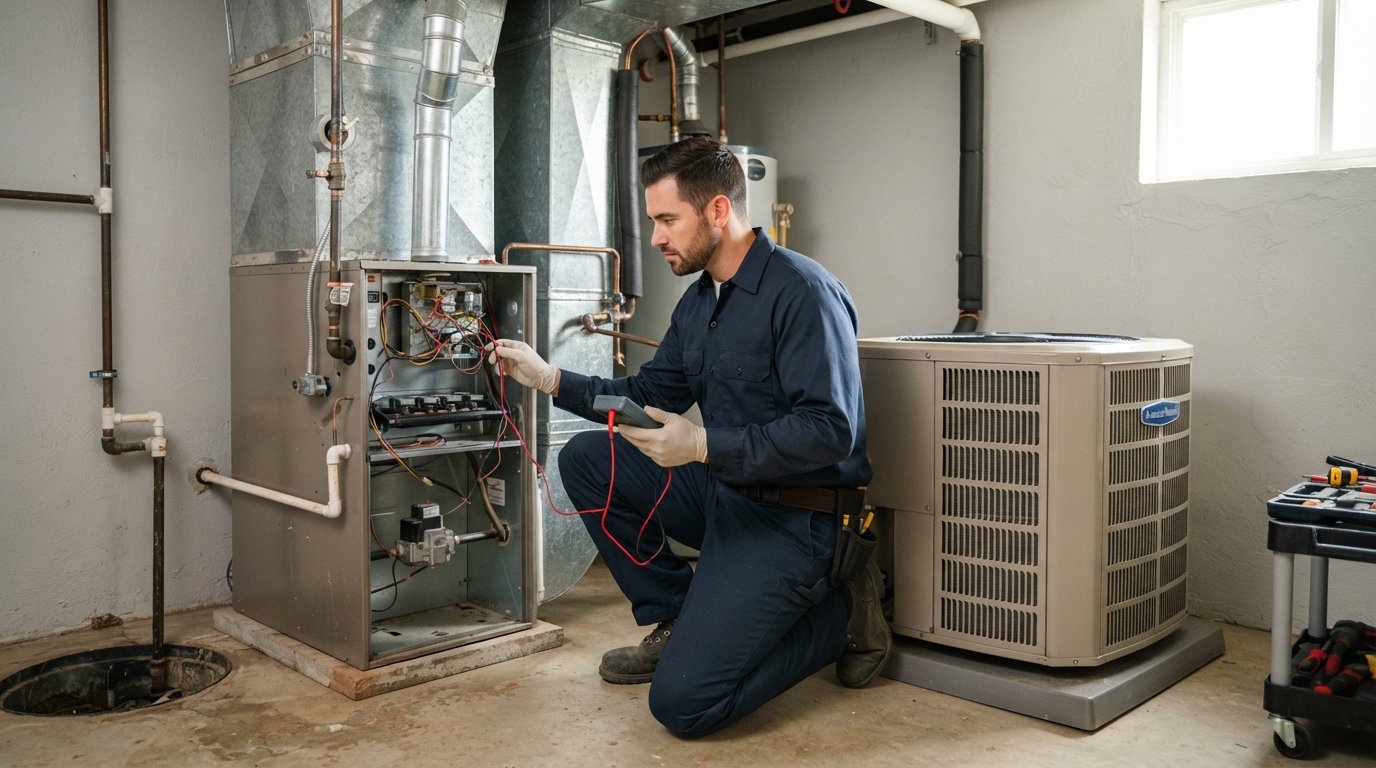
Heat Pump vs Furnace: Cost and Efficiency Comparison
Compare heat pump vs furnace cost and efficiency with real numbers, rebates, and climate tips. Call (833)-700-4293 for expert guidance.

By Maya Bennett
Learn more about Central Air Conditioning Repair or Maintenance for guides, costs, and what to expect.
Compare Central Air Conditioning Repair or Maintenance Pros Near You

Enter your ZIP code to compare top-rated local professionals and request free quotes.
Choosing between a heat pump and a furnace is one of the most consequential decisions a homeowner can make for comfort, monthly bills, and long-term carbon footprint. The right answer depends less on brand loyalty and more on your climate, your ductwork, and how long you plan to stay in the home. A heat pump moves heat rather than generating it, while a furnace burns fuel to create warmth. That fundamental difference drives everything from installation price to winter performance. This heat pump vs furnace cost and efficiency comparison breaks down the numbers, the rebates, and the scenarios where each system wins.
How Heat Pumps and Furnaces Actually Differ
A heat pump works like a reversible air conditioner. In summer it pulls heat from indoor air and releases it outside. In winter it reverses the process, extracting ambient heat from outdoor air (or ground) and moving it indoors. Because it moves heat instead of creating it, a heat pump can deliver more than one unit of heat per unit of electricity consumed. Modern cold-climate models maintain capacity well below freezing, though output and efficiency decline as temperatures drop.
A furnace generates heat directly. Gas furnaces burn natural gas or propane in a heat exchanger, while electric furnaces use resistance coils. Gas furnaces reach high temperatures quickly and perform consistently regardless of outdoor conditions. Electric furnaces are cheap to buy but expensive to run in most markets. The trade-off is clear: heat pumps excel at moderate climates and efficient operation, while furnaces dominate in extreme cold and when fast, intense heat is the priority.
For homeowners planning a replacement or new installation, understanding this mechanical difference is the foundation for every cost and efficiency calculation that follows. It also explains why a hybrid system, pairing a heat pump with a gas furnace, has become a popular compromise in mixed climates.
Installed Cost Ranges by Home Size
Upfront cost is usually the first question, and the answer varies widely by region, home size, and whether ductwork already exists. The table below reflects typical installed ranges for standard efficiency equipment, including labor, permits, and basic materials. High-efficiency or variable-speed models can push costs 20 to 40 percent higher.
- 1,500 sq ft home: Heat pump $4,500 to $8,000; gas furnace $3,000 to $6,000
- 2,000 sq ft home: Heat pump $6,000 to $11,000; gas furnace $4,000 to $8,000
- 2,500 sq ft home: Heat pump $8,000 to $14,000; gas furnace $5,000 to $10,000
- 3,000+ sq ft home: Heat pump $10,000 to $18,000; gas furnace $6,000 to $12,000
These figures assume existing ductwork in good condition. If ducts need sealing, repair, or replacement, add $2,000 to $6,000. Homes without ducts face a larger gap: ductless mini-split heat pumps can cost $5,000 to $12,000 for multiple zones, while adding full ductwork for a furnace can exceed $10,000. In that scenario, ductless heat pumps often become the more practical financial choice.
It is also worth noting that heat pump installation may require electrical panel upgrades, especially in older homes. A 200-amp panel is usually sufficient, but homes with 100-amp service may need an upgrade costing $1,500 to $3,500. Gas furnaces may require new gas lines or venting modifications, which can add $500 to $2,500. Always request itemized quotes so you can compare apples to apples. Platforms like FreeQuotes.Contractors let you gather multiple pre-vetted bids quickly, which is the single best way to avoid overpaying for either system.
Operating Cost and Efficiency: Where the Math Gets Interesting
Efficiency ratings tell a nuanced story. Gas furnaces use Annual Fuel Utilization Efficiency (AFUE). A standard furnace is 80 percent AFUE, while a high-efficiency condensing furnace reaches 96 to 98 percent AFUE. Heat pumps use Heating Seasonal Performance Factor (HSPF2) and Seasonal Energy Efficiency Ratio (SEER2). A good cold-climate heat pump might have an HSPF2 of 9 to 10 and a SEER2 of 15 to 20.
Translating ratings into dollars requires local fuel prices. As a rule of thumb, a heat pump becomes more economical than a gas furnace when electricity costs are moderate and gas prices are high. In regions with cheap natural gas (under $1.20 per therm) and expensive electricity (over $0.20 per kWh), a high-efficiency furnace often wins on operating cost. In regions with cheap electricity (under $0.12 per kWh) or expensive propane, heat pumps usually cost less to run.
Consider a 2,000 sq ft home in a mixed climate. A 96 percent AFUE furnace might use 600 therms per winter at $1.30 per therm, costing $780. A cold-climate heat pump with an HSPF2 of 9 might use 6,500 kWh at $0.14 per kWh, costing $910. But swap in a $1.80 per therm gas rate or a $0.10 per kWh electric rate and the heat pump pulls ahead. Because these variables shift, the most reliable approach is to run a load calculation and compare local rates before deciding. A qualified HVAC contractor can perform this analysis during a quote visit.
Cold-Climate Performance Limits and Hybrid Systems
Older heat pumps struggled below 30 degrees Fahrenheit. Modern cold-climate models maintain rated capacity down to 5 degrees Fahrenheit and can operate at reduced capacity to minus 13 degrees Fahrenheit. Below that, they rely on supplemental electric resistance heat, which is expensive. In climates where winter temperatures routinely drop below 10 degrees Fahrenheit, a standalone heat pump may struggle to keep up without a backup source.
This is where hybrid systems shine. A hybrid (or dual-fuel) system pairs a heat pump with a gas furnace. The heat pump handles mild weather, and the furnace takes over when temperatures plunge. The switchover point is set by the installer, often around 30 to 35 degrees Fahrenheit. This setup captures the efficiency of a heat pump for most of the year while preserving the cold-weather reliability of a furnace.
Hybrid systems typically cost $8,000 to $15,000 installed, roughly 15 to 25 percent more than a standalone furnace or heat pump. However, they can reduce annual heating costs by 20 to 40 percent compared to a furnace alone, depending on climate and fuel prices. For homeowners in the Midwest, Northeast, and Mountain West, a hybrid system is often the most sensible long-term investment. It also future-proofs the home as electrification incentives continue to expand.
Tax Credits and Rebates That Shift the Math
Federal, state, and utility incentives can dramatically change the payback period for a heat pump. The Inflation Reduction Act created the High-Efficiency Electric Home Rebate Act (HEEHRA) and expanded the Energy Efficient Home Improvement Credit (25C). As of 2026, homeowners can claim up to $2,000 annually for a qualifying heat pump under 25C, with a total annual cap of $3,200 across eligible improvements.
Low- and moderate-income households may qualify for even larger rebates under HEEHRA, covering up to $8,000 for a heat pump, plus additional amounts for electrical panel upgrades and insulation. Many utilities also offer $500 to $3,000 rebates for high-efficiency heat pumps. Gas furnace rebates are far less common and typically smaller, often $100 to $500.
These incentives can reduce the upfront premium of a heat pump to near parity with a furnace. For example, a $10,000 heat pump with a $2,000 federal credit and a $1,500 utility rebate nets out to $6,500, which is competitive with a $6,000 furnace. Homeowners should check the Database of State Incentives for Renewables and Efficiency (DSIRE) and consult their utility before purchasing. A knowledgeable contractor can often help identify and file for available rebates.
How Ductwork Condition Affects Your Choice
Ductwork is the hidden variable in most heating decisions. Leaky, undersized, or poorly insulated ducts can waste 20 to 30 percent of the energy a heat pump or furnace produces. For heat pumps, duct condition matters even more because they move larger volumes of lower-temperature air than furnaces. If ducts are too small or leaky, a heat pump will struggle to distribute heat evenly, leading to comfort complaints and higher bills.
Before choosing between a heat pump and a furnace, have a contractor perform a duct leakage test and a static pressure measurement. If ducts are in poor condition, budget for sealing and insulation, which typically costs $1,500 to $4,000. In some cases, replacing undersized ducts is necessary, adding $3,000 to $8,000. These costs apply to both system types, but heat pumps are more sensitive to duct deficiencies.
Homes without ducts face a different calculus. Ductless mini-split heat pumps avoid duct losses entirely and can be installed room by room. They are often the best choice for additions, older homes, and properties where adding ductwork is impractical. For homes with existing ducts in good condition, a central heat pump or furnace remains the most straightforward path.
Lifespan, Maintenance, and Long-Term Value
A well-maintained gas furnace lasts 15 to 20 years. Heat pumps typically last 12 to 15 years because they run year-round, though cold-climate models with inverter compressors are closing that gap. Annual maintenance for either system costs $100 to $250. Heat pumps require both heating and cooling checks, so maintenance costs may be slightly higher over the life of the unit.
However, heat pumps provide both heating and cooling in one package, eliminating the need for a separate air conditioner. That can save $3,000 to $6,000 upfront compared to buying a furnace and a central AC. When you factor in that dual function, the total cost of ownership for a heat pump often beats a furnace-plus-AC combination, especially with incentives.
Resale value is another consideration. Homes with efficient electric heat pumps and modern HVAC systems appeal to buyers concerned about energy costs and climate impact. In some markets, appraisers and real estate agents note that heat pumps can command a modest premium. As electrification trends continue, that advantage may grow.
Making the Decision: A Practical Framework
To choose wisely, start with your climate. If winter temperatures rarely drop below 20 degrees Fahrenheit, a standalone heat pump is usually the most efficient and cost-effective choice. If you routinely see single digits or below, a hybrid system or a high-efficiency gas furnace is safer. Next, compare local fuel prices using the formulas above. Then factor in available rebates and tax credits, which can erase the heat pump premium.
Finally, assess your ductwork and electrical panel. Poor ducts or an undersized panel can add thousands to either project, so get those inspected before committing. The best way to navigate this complexity is to gather multiple quotes from licensed, insured contractors who can perform a Manual J load calculation and explain their recommendations in plain language. That process not only protects your wallet but also ensures the system you choose is sized correctly for your home.
Whether you lean toward a heat pump, a furnace, or a hybrid, the goal is the same: reliable comfort at a predictable cost. With the right information and a few competitive bids, you can make a decision that pays off for years to come.