
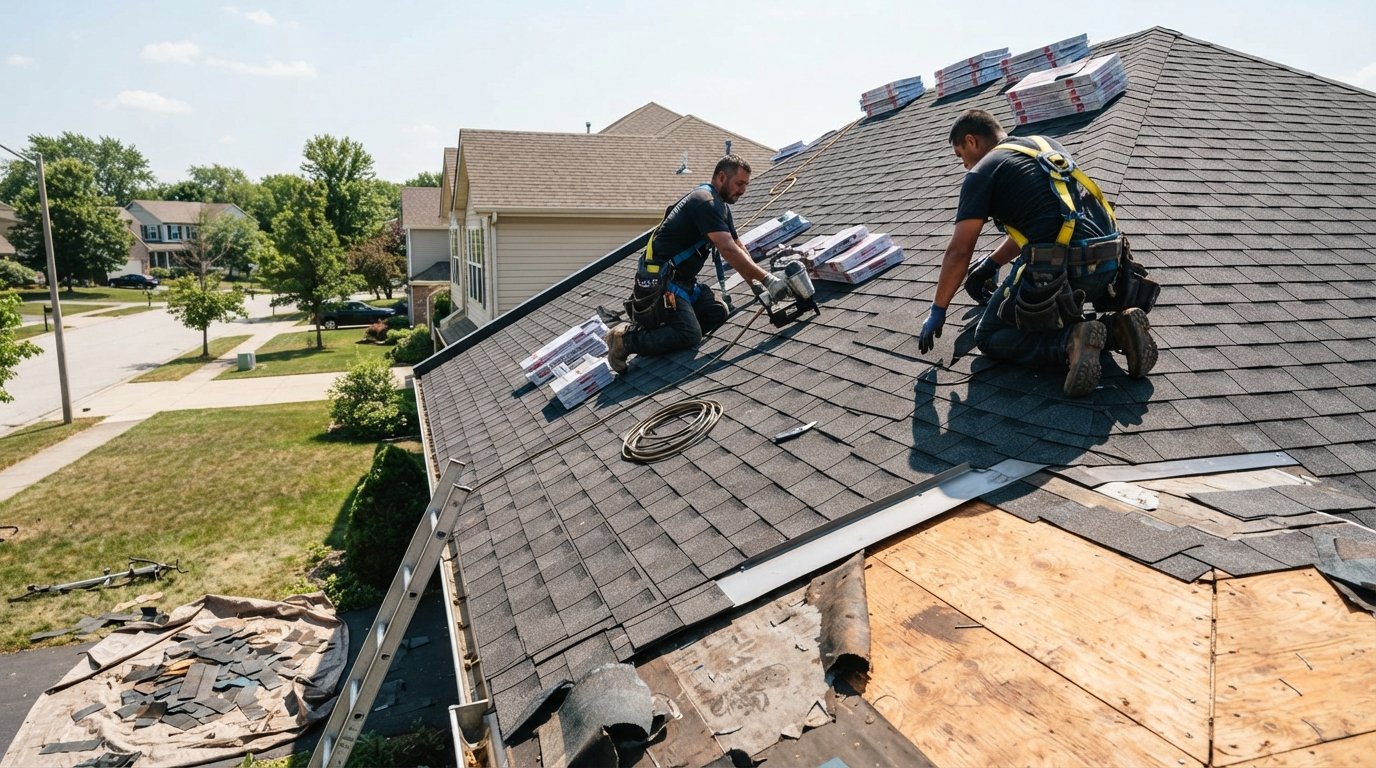
Average Cost to Replace a Roof With Architectural Shingles
See what the average cost to replace a roof with architectural shingles runs by region and roof type. Call (833)-700-4293 for trusted local quotes.

By Andrew Parker
Learn more about Roof Repair or Maintenance for guides, costs, and what to expect.
Compare Roof Repair or Maintenance Pros Near You

Enter your ZIP code to compare top-rated local professionals and request free quotes.
Your roof is one of the few home components you cannot afford to ignore, and when it starts curling, leaking, or shedding granules, the question of replacement moves from a vague worry to a pressing line item. Architectural shingles, also called dimensional or laminated shingles, are the most popular roofing choice in the United States for good reason: they balance durability, curb appeal, and upfront price better than almost any alternative. But what does that balance actually cost? The average cost to replace a roof with architectural shingles typically falls between $8,000 and $20,000 for a standard single-family home, with most homeowners landing near the $12,000 mark. That wide range reflects real variables like roof size, pitch, regional labor rates, and how much underlying repair your deck needs. This guide breaks down those variables so you can walk into the bidding process with realistic numbers and a clear plan for comparing proposals.
What Drives the Price of an Architectural Shingle Roof
Architectural shingles cost more than basic three-tab shingles, usually 20 to 40 percent more per square, but they last longer and carry stronger manufacturer warranties. The final invoice, though, is rarely just shingles times square footage. Roofing contractors build a proposal from several cost layers: materials, labor, tear-off and disposal, underlayment, flashing, ventilation, and any decking repairs discovered once the old roof is removed. Each layer has its own price range, and regional labor markets shift the totals significantly.
To make sense of bids, you need to understand how roofers measure. They price by the "square," which equals 100 square feet of roof surface. A typical home has a roof area of 20 to 30 squares, though that footprint includes overhangs, valleys, and slopes that add material and time. Most contractors also calculate a waste factor of 10 to 15 percent to account for cuts and overlaps. When you request quotes, ask each contractor to state the number of squares they measured and whether that figure includes waste.
Material costs for architectural shingles generally run $100 to $150 per square for the shingles themselves, plus $30 to $50 per square for underlayment, starter strips, ridge caps, and nails. Labor adds $150 to $300 per square depending on your region and the complexity of the roof. That puts the installed cost of a basic architectural shingle roof at roughly $350 to $550 per square before tear-off, decking, and upgrades. A 25-square roof at $450 per square, for example, lands near $11,250 before extras.
Average Cost Per Square and Per Square Foot by Region
Regional pricing swings widely because labor rates, permit fees, and disposal costs vary by market. The table below summarizes typical installed ranges for architectural shingle replacement, including tear-off of a single layer and standard underlayment, but excluding decking repairs and premium upgrades.
- Northeast (New York, Boston, Philadelphia): $450 to $650 per square, or $4.50 to $6.50 per square foot.
- Mid-Atlantic and Midwest (Chicago, Columbus, Kansas City): $375 to $550 per square, or $3.75 to $5.50 per square foot.
- South and Southeast (Atlanta, Dallas, Charlotte): $325 to $475 per square, or $3.25 to $4.75 per square foot.
- Mountain West (Denver, Salt Lake City, Boise): $400 to $575 per square, or $4.00 to $5.75 per square foot.
- West Coast (Seattle, Portland, Sacramento): $425 to $625 per square, or $4.25 to $6.25 per square foot.
These ranges assume an asphalt shingle roof with moderate pitch and good access. Urban markets with tight lots, historic district requirements, or high permit fees push toward the top of each range. Rural areas with fewer contractors may see higher labor costs due to travel, even though material prices are similar. Always ask whether a quote includes permit fees, since those can add $150 to $600 depending on the jurisdiction.
For a quick mental check, multiply your roof's square footage by the per-square-foot rate for your region. A 2,000-square-foot roof in the Midwest at $4.50 per square foot comes to about $9,000, while the same roof in the Northeast at $5.50 per square foot comes to $11,000. These are planning numbers, not final bids, but they help you spot outliers when proposals arrive.
How Roof Pitch, Tear-Off Layers, and Decking Condition Change the Price
Roof pitch is one of the most underestimated cost drivers. Walkable roofs with a pitch of 4:12 or less are faster and safer to work on, so contractors price them at the low end of labor ranges. Steep roofs (7:12 and above) require harnesses, roof jacks, and slower movement, adding 20 to 40 percent to labor. Complex rooflines with multiple valleys, dormers, and chimneys also slow the crew and increase waste, pushing costs upward even on moderate pitches.
Tear-off layers matter just as much. Removing one layer of old shingles is standard and usually included in the per-square price. If your home has two or three layers, expect an additional $50 to $150 per square for labor and disposal, because the crew must strip more material and pay higher dump fees. Some homeowners ask whether they can shingle over the old roof to save money. Most building codes allow it only up to two layers total, and doing so hides decking problems, shortens the new roof's lifespan, and may void the manufacturer warranty. A reputable contractor will recommend full tear-off in almost every case.
Decking condition is the wild card. Once the old shingles are off, the crew inspects the wood sheathing for rot, soft spots, and delamination. Replacing a few sheets of plywood or oriented strand board costs $75 to $150 per sheet installed, and a roof with widespread moisture damage can require $1,500 to $4,000 in decking repairs. That is why a trustworthy bid includes a per-sheet price for decking replacement rather than a vague allowance. If your roofer cannot tell you the per-sheet rate upfront, ask before signing. For urgent situations where leaks are already active, our guide on emergency roof leak first steps explains how to stabilize the roof before replacement begins.
Ventilation and Flashing Upgrades That Appear as Add-Ons
Ventilation and flashing are the line items homeowners most often overlook, yet they are critical to roof performance and frequently appear as add-ons in a proposal. Proper attic ventilation moves hot, moist air out of the attic and pulls fresh air in through soffit vents, protecting the roof deck and shingles from premature aging. If your current ventilation is inadequate, the contractor may recommend ridge vents, additional soffit vents, or a powered vent, adding $300 to $1,200 depending on the scope. These upgrades are not upsells for their own sake; inadequate ventilation can void shingle warranties and contribute to ice dams in cold climates.
Flashing protects the seams where the roof meets walls, chimneys, skylights, and valleys. Old flashing is often reused in cheap bids, but reusing corroded or improperly installed flashing is a leading cause of leaks. New step flashing, counterflashing, and valley metal typically add $200 to $800 to a full replacement, with chimney flashing repairs costing $300 to $600 alone. Ask each contractor whether the bid includes new flashing at all penetrations or only at some. The difference in price is small compared to the cost of tracing a leak later.
Other common add-ons include drip edge, which directs water away from fascia boards ($150 to $400), and ice and water shield in valleys and along eaves, which is required in many cold-climate jurisdictions ($200 to $600). Some contractors also offer synthetic underlayment upgrades or premium ridge cap shingles for a more finished look. None of these items should appear as a surprise after work begins. A well-written proposal lists them explicitly with unit prices, so you can compare bids line by line.
How to Compare Multiple Roofing Bids on an Apples-to-Apples Basis
Comparing roofing bids is not as simple as picking the lowest number. A bid that looks cheap may exclude tear-off, flashing, or permit fees, and a bid that looks high may include premium underlayment and a longer workmanship warranty. The goal is to normalize every proposal to the same scope so you can see what each contractor actually delivers for the price. Start by requesting written proposals that break costs into categories rather than a single lump sum.
Use the following checklist to line up bids side by side. Ask each contractor to address every item in writing:
- Scope and measurements: Confirm the number of squares, the waste factor, and whether the price includes tear-off of all existing layers and disposal.
- Materials and specifications: Note the shingle brand, product line, warranty tier, underlayment type, and whether new flashing and drip edge are included.
- Decking policy: Request a per-sheet price for decking replacement and a clear statement of how the contractor documents and bills for unforeseen repairs.
- Ventilation and code items: Verify whether the bid includes ridge and soffit ventilation, ice and water shield, and permit fees required by your municipality.
- Warranty and timeline: Compare the manufacturer warranty, the contractor's workmanship warranty, the projected start date, and the estimated completion time.
Once bids are normalized, price differences usually reflect labor quality, warranty terms, and overhead rather than arbitrary markups. A contractor who is 10 to 15 percent higher than the lowest bid but includes new flashing, upgraded underlayment, and a five-year workmanship warranty is often the better value. Be cautious of bids that are dramatically lower than the rest; they frequently rely on change orders once the roof is open. If you want to pressure-test your numbers against real local quotes, you can request free contractor quotes and compare them to the ranges in this guide.
Finally, verify licensing and insurance before signing. Ask for the contractor's license number, certificate of insurance for general liability and workers' compensation, and references from recent jobs in your area. A professional roofer will provide these without hesitation, and a contractor who resists is not worth the risk on a project this large.
What the Total Investment Looks Like in Practice
Pulling the pieces together, a typical architectural shingle replacement on a 25-square roof with a single layer of tear-off, standard flashing, and adequate existing ventilation runs $9,000 to $14,000 in most U.S. markets. Add a steep pitch and two layers of tear-off, and the same roof can climb to $15,000 to $20,000. Premium shingle lines, new decking, and ventilation upgrades can push a complex project above $25,000, but those cases usually involve larger homes or significant structural repairs.
It also helps to think in terms of cost per year of service. Architectural shingles typically carry 25- to 30-year manufacturer warranties and often last longer with proper ventilation and maintenance. Spread over three decades, a $12,000 roof costs roughly $400 per year, which is a useful framing when comparing replacement against repeated patch repairs. Patch work on a failing roof rarely buys more than a season or two, and each repair adds up while the underlying problem remains.
Budget for the unexpected but keep it in proportion. Setting aside 10 to 15 percent of the bid for potential decking repairs is prudent, and it is far better to plan for that contingency than to be surprised mid-project. Most reputable contractors will pause work and document any hidden damage with photos before proceeding, giving you the chance to approve additional costs in writing.
Replacing a roof with architectural shingles is a major purchase, but it is also one of the most predictable home improvement projects when you understand the cost structure. Measure your roof or ask for measurements, gather at least three written bids, normalize them against the checklist above, and verify licensing and insurance before signing. With realistic expectations and apples-to-apples comparisons, you can choose a contractor with confidence and protect your home for decades to come.