
Spray Foam vs Fiberglass Insulation for Attics: Which Wins in 2026?
Compare spray foam vs fiberglass insulation for attics on cost, R-value, and comfort. Call (833)-700-4293 for expert guidance today.

By Claire Foster
Find Local Pros Near You

Enter your ZIP code to compare top-rated local professionals and request free quotes.
Your attic is either your home's hardest-working energy asset or its biggest hidden liability. If you have ever climbed into a sweltering attic in July or felt a cold draft bleeding through the ceiling in January, you already understand why insulation decisions matter. The choice between spray foam and fiberglass insulation for attics is one of the most consequential upgrades a homeowner can make, influencing monthly utility bills, indoor comfort, indoor air quality, and even the resale value of your property. Yet the debate is rarely settled by a simple answer, because each material performs differently depending on your climate, your budget, your attic configuration, and your long-term goals.
This guide breaks down how both materials work, where each one excels, what they cost, and how to decide which option fits your home. Along the way, you will see why thousands of homeowners use platforms like FreeQuotes.Contractors to compare vetted local insulation professionals and request free, competitive quotes before committing to a project.
How Spray Foam and Fiberglass Insulation Actually Work
Understanding the fundamental difference between these two materials starts with how they manage heat and air. Fiberglass insulation, which has been the standard in American homes for decades, works primarily by trapping air within millions of tiny glass fibers. This trapped air slows the transfer of heat through conduction. Fiberglass comes in two main forms for attic applications: batts (pre-cut rolls that fit between joists) and loose-fill (shredded material blown into place). Both are porous, meaning air can still move through them if the surrounding assembly is not properly air-sealed.
Spray foam insulation takes a different approach. It is applied as a liquid that expands rapidly, typically 30 to 100 times its original volume, and then cures into a solid mass. This expansion allows it to fill gaps, cracks, and irregular cavities that batts and loose-fill simply cannot reach. More importantly, spray foam acts as both an insulator and an air barrier in a single application. That dual function is the core of its performance advantage, because air leakage, not conduction, is responsible for a large share of energy loss in most attics.
There are two primary types of spray foam used in attics. Open-cell foam is lighter, softer, and less expensive, with an R-value of roughly 3.5 to 3.8 per inch. Closed-cell foam is denser, heavier, and more expensive, delivering an R-value of about 6.5 to 7 per inch while also adding structural rigidity and acting as a vapor retarder. Fiberglass, by comparison, delivers an R-value of approximately 2.9 to 3.8 per inch depending on the product form.
Comparing Performance: R-Value, Air Sealing, and Moisture Control
R-value measures resistance to heat flow, and it is the metric most homeowners recognize. On paper, the numbers seem straightforward: closed-cell spray foam delivers more R-value per inch than fiberglass, while open-cell foam and high-density fiberglass are closer to parity. But raw R-value tells only part of the story in an attic environment, because it assumes the insulation is installed perfectly with no air gaps and no moisture intrusion. In real-world attics, that assumption often fails.
Fiberglass batts, for example, can lose a significant portion of their rated R-value if they are compressed, if they leave gaps around wiring and plumbing penetrations, or if wind washing moves air through the porous material. Loose-fill fiberglass performs better in irregular spaces because it conforms more easily, but it still relies on a separate air-sealing step to reach peak efficiency. Spray foam eliminates these variables because it bonds directly to the surface and expands into every crevice, creating a continuous, seamless barrier.
Moisture control is another critical differentiator. Fiberglass does not absorb moisture in the way cellulose does, but it can trap moisture-laden air against cold surfaces, potentially leading to condensation and mold growth if the attic assembly is not properly vented. Closed-cell spray foam resists moisture absorption and can serve as a vapor barrier, which is a major advantage in humid climates. Open-cell foam is more vapor-permeable, which can be beneficial in certain mixed-humid climates where some drying potential is desirable. The right choice depends heavily on your climate zone and the specific design of your roof assembly.
Here is a quick comparison of the key performance factors homeowners should weigh:
- R-value per inch: Closed-cell spray foam leads (about 6.5 to 7), followed by open-cell foam and high-density fiberglass (about 3.5 to 3.8), then standard fiberglass batts (about 2.9 to 3.3).
- Air sealing: Spray foam provides an integrated air barrier; fiberglass requires a separate air-sealing step with caulk or foam.
- Moisture behavior: Closed-cell foam resists vapor; open-cell foam allows some drying; fiberglass needs careful venting to avoid condensation issues.
- Installation speed: Fiberglass batts install quickly in open, accessible attics; spray foam requires specialized equipment and curing time.
- Durability: Spray foam maintains performance for decades with minimal settling; loose-fill fiberglass can settle over time, reducing effective R-value.
These differences explain why energy auditors often recommend spray foam for attics with complex geometry, ductwork located in the attic, or persistent comfort complaints. Fiberglass remains a strong contender when the attic is simple, well-vented, and already air-sealed, or when budget constraints are the dominant factor.
Cost Breakdown: What You Will Actually Pay
Cost is where the spray foam vs fiberglass insulation for attics debate gets practical fast. Fiberglass is almost always cheaper on a per-square-foot basis, but the true cost comparison depends on whether you need additional air-sealing work, how much R-value you are targeting, and whether you are insulating a vented or unvented attic.
As a general range, fiberglass batts for an attic floor typically cost between $0.60 and $1.50 per square foot installed, while loose-fill fiberglass runs about $0.90 to $2.00 per square foot installed. Spray foam is more expensive: open-cell foam generally ranges from $1.50 to $3.50 per square foot installed, and closed-cell foam can run $2.50 to $5.00 or more per square foot depending on thickness and regional labor rates.
However, those numbers do not tell the whole story. If your attic has significant air leaks, you will need to pay for air sealing before or alongside fiberglass installation. When you factor in that labor, the gap between fiberglass plus air sealing and open-cell spray foam narrows considerably. Spray foam also tends to reduce HVAC runtime, which can lower monthly energy bills by 15 to 30 percent in many homes, according to energy efficiency studies. Over a 10 to 15 year horizon, those savings can offset a meaningful portion of the upfront premium.
Homeowners should also consider available incentives. Federal tax credits, utility rebates, and state energy programs frequently cover a portion of insulation upgrades, and spray foam often qualifies for higher rebate tiers because of its superior performance. A qualified contractor can help you identify which incentives apply in your area and factor them into your project budget.
Which Attic Configuration Favors Which Material
The physical layout of your attic plays a decisive role in material selection. A simple, open attic with a flat floor, easy access, and no ductwork is a natural fit for fiberglass batts or loose-fill. Installation is fast, material costs are low, and performance is predictable as long as air sealing is done correctly. This is the classic scenario where fiberglass makes practical and financial sense.
Complex attics change the calculus. If your attic houses HVAC equipment, ductwork, or a lot of plumbing penetrations, fiberglass becomes harder to install effectively because every penetration creates a potential air leak and a spot where batts must be cut and fitted. Spray foam excels here because it seals around obstructions in a single pass. Similarly, attics with sloped ceilings, knee walls, or irregular framing benefit from spray foam's ability to conform to odd shapes.
The choice between vented and unvented attic design is another major factor. In a vented attic, insulation typically sits on the attic floor, and the attic itself remains close to outdoor temperature. Fiberglass works well in this setup when paired with proper ventilation and air sealing. In an unvented or conditioned attic, insulation is applied to the roof deck and gable walls, bringing the attic inside the building envelope. Spray foam is the preferred material for unvented attics because it can seal the roof assembly and manage moisture without relying on continuous ventilation.
Climate also matters. In hot, humid climates like the Southeast, closed-cell spray foam's vapor resistance helps prevent moisture problems that can plague fiberglass in unvented assemblies. In cold climates, spray foam reduces ice damming risk by keeping the roof deck warmer and preventing heat from escaping into the attic. In mild, dry climates, fiberglass can perform very well at a lower cost, provided air sealing is thorough.
Installation Process and What to Expect
Understanding the installation process helps homeowners set realistic expectations for timeline, disruption, and quality control. Fiberglass batts are typically installed in a single day for an average attic. The installer lays batts between joists, cuts around obstructions, and ensures proper coverage. Loose-fill fiberglass is blown in using a hose and machine, which is faster for large open areas but requires careful depth monitoring to achieve the target R-value.
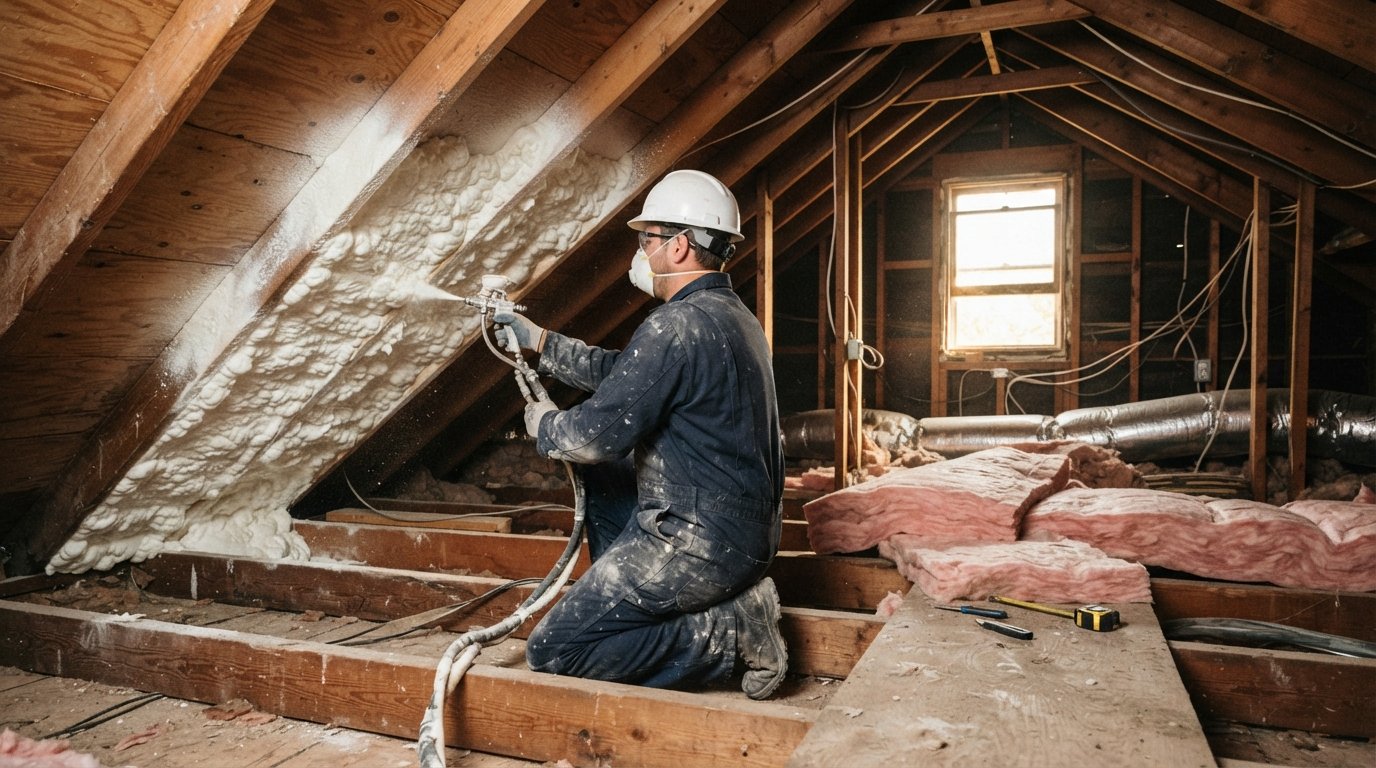
Spray foam installation is more involved. The installer suits up in protective gear, uses a proportioner and spray gun to mix two chemical components at the tip, and applies the foam in passes. Open-cell foam is usually applied in a single thick pass, while closed-cell foam is often applied in lifts of 1 to 2 inches to allow proper curing and to avoid excessive heat buildup. The foam expands within seconds and cures within hours to a day, depending on thickness and humidity. Most attic spray foam projects are completed in one to two days.
Both materials require the homeowner to prepare the space by removing stored items and ensuring clear access. Spray foam projects generate fumes during application, so occupants typically vacate the home for 24 hours. Fiberglass installation produces dust and fibers, so wearing masks and sealing off living spaces is wise. In both cases, hiring a licensed, insured professional is the safest and most reliable path, especially because improper installation can void manufacturer warranties and compromise performance.
Pros and Cons at a Glance
To summarize the trade-offs, here is a balanced look at each material's strengths and weaknesses in attic applications.
Spray foam advantages:
- Superior air sealing and higher effective R-value per inch
- Excellent performance in complex, irregular, or unvented attics
- Moisture management benefits, especially with closed-cell foam
- Can reduce HVAC load and improve indoor comfort noticeably
- Long lifespan with minimal settling or degradation
Spray foam drawbacks:
- Higher upfront cost than fiberglass
- Requires specialized equipment and trained installers
- Some products emit odors during curing and require vacating the home
- Closed-cell foam uses blowing agents with higher global warming potential than some alternatives
Fiberglass advantages:
- Lower material and installation cost
- Widely available and familiar to most contractors
- Easy to inspect and top off over time
- Non-combustible and resistant to mold growth when kept dry
- Effective in simple, well-vented attic assemblies
Fiberglass drawbacks:
- Requires separate air sealing to perform at its best
- Can lose effective R-value through compression, gaps, or wind washing
- Loose-fill can settle over time, reducing performance
- Less effective in complex or unvented attic configurations
Making the Right Choice for Your Home
There is no universally correct answer to the spray foam vs fiberglass insulation for attics question. The best choice depends on a careful evaluation of your attic's design, your climate, your budget, and your long-term energy goals. Homeowners who plan to stay in their home for many years and want maximum comfort and efficiency often find that spray foam delivers the strongest return on investment. Homeowners with simple attics, tighter budgets, or short-term timelines may find that fiberglass plus thorough air sealing meets their needs at a lower upfront cost.
What matters most is that the insulation decision is made as part of a complete attic strategy: air sealing, ventilation, moisture control, and proper installation all work together. A qualified insulation contractor can assess your attic, recommend the right material and R-value target, and provide a detailed estimate that accounts for your specific conditions. Getting multiple quotes from vetted professionals is the single most effective way to ensure you are paying a fair price for quality work.
Whether you choose spray foam, fiberglass, or a hybrid approach, upgrading your attic insulation is one of the highest-impact home improvements available to you. It lowers energy bills, improves comfort in every room, reduces strain on your HVAC system, and contributes to a healthier, more durable home. Take the time to compare options, ask questions, and hire a professional you trust, and you will enjoy the benefits of a well-insulated attic for decades to come.