
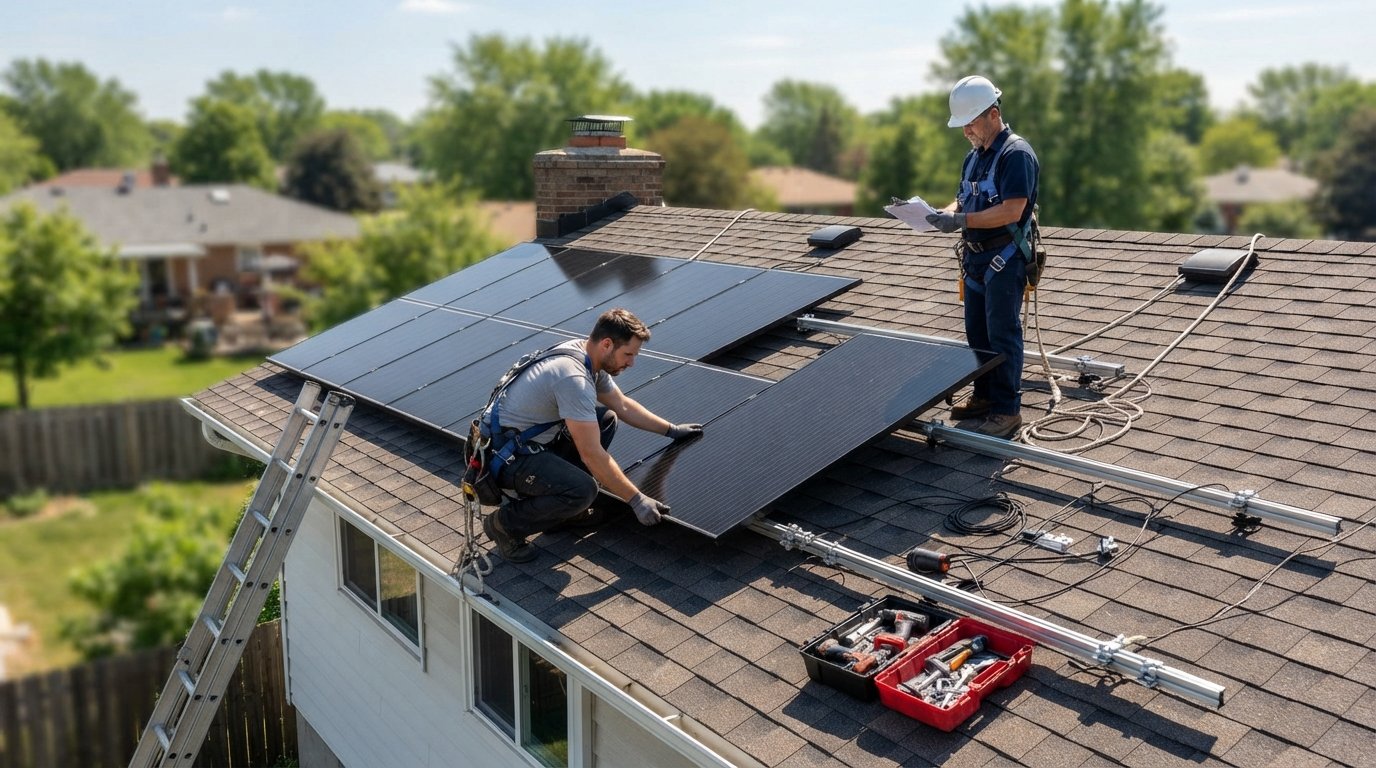
Solar Panel Cost Breakdown by System Size: 4kW to 10kW
Solar panel cost breakdown by system size, from 4kW to 10kW, with real price ranges and per-watt math. Call (833)-700-4293 for local installer quotes.

Learn more about Solar Panel Installation and Repair for guides, costs, and what to expect.
Compare Solar Panel Installation and Repair Pros Near You

Enter your ZIP code to compare top-rated local professionals and request free quotes.
Solar sticker shock often comes from a single number on a quote, but the real story lives in the details. A 6 kW system in one state can cost thousands more than the same size system two states over, and two installers can quote the same wattage with very different equipment and fee structures. Understanding a solar panel cost breakdown by system size turns that single number into a map: you see where every dollar goes, why a 10 kW array is not simply double the price of a 5 kW array, and how to compare bids without getting lost in jargon. Whether you are eyeing a small starter array or a whole-roof powerhouse, this guide walks through real price ranges, the equipment and soft costs that drive them, and the per-watt metric that keeps every quote honest.
What Solar Panel Cost Breakdown by System Size Actually Tells You
A system size is measured in kilowatts (kW) of direct current capacity, and it tells you the maximum output the panels can produce under ideal conditions. But cost does not scale in a straight line. A 4 kW system might run $2.80 per watt, while a 10 kW system could land closer to $2.40 per watt, because certain fixed costs (permits, design, truck rolls, interconnection paperwork) are spread across more watts. That is why a solar panel cost breakdown by system size is more useful than a single average price per watt: it separates the fixed costs from the variable ones and shows where you can negotiate or economize.
Before diving into numbers, it helps to know what a typical residential system includes: panels, inverters, racking and mounting hardware, wiring, a monitoring system, permits, inspection fees, and labor. Some quotes bundle a main panel upgrade or a battery; others leave those as add-ons. The ranges below reflect common U.S. residential pricing before any federal tax credit or local rebate, and they assume a standard pitched roof in reasonable condition. Your own quote will vary with location, roof complexity, and equipment tier.
Typical Price Ranges for 4kW, 6kW, 8kW, and 10kW Systems
Across the United States, most residential solar installations fall between $2.40 and $3.20 per watt installed. That translates to roughly $9,600 to $12,800 for a 4 kW system, $14,400 to $19,200 for 6 kW, $19,200 to $25,600 for 8 kW, and $24,000 to $32,000 for 10 kW. These are broad ranges because solar pricing is intensely local: labor markets, permitting fees, utility interconnection rules, and even roof type can swing a quote by 20 percent or more. Use these figures as a sanity check, not a final budget.
Panel count is the most visible variable. A 4 kW system typically uses 10 to 11 panels at 370 to 400 watts each, while a 10 kW system needs 25 to 27 panels. But panel count alone does not explain the cost difference. The inverter type matters just as much: a string inverter is one central unit sized to the array, while microinverters sit behind each panel and add roughly $0.20 to $0.40 per watt. Enphase and SolarEdge systems are common examples, and the choice affects both upfront cost and long-term maintenance. Roof complexity, shading, and the distance from the array to the electrical panel also influence labor and wiring costs, sometimes adding $1,000 to $3,000 to a project regardless of size.
Here is a quick reference for how the major cost buckets typically break down on a mid-range 8 kW system, which is a common size for a family home:
- Panels and racking: $6,000 to $8,000 (about 30 to 35 percent of the total)
- Inverter and electrical equipment: $3,000 to $4,500
- Labor and installation: $3,500 to $5,000
- Permits, inspection, and interconnection: $500 to $1,500
- Sales, design, and overhead: $3,000 to $5,000
Notice how the soft costs (permits, design, sales) do not shrink proportionally when you downsize. A 4 kW system still needs a permit, a design, and a site visit, so those fixed costs eat a larger share of a smaller project. That is the single biggest reason per-watt pricing improves as system size grows.
How Panel Count, Inverter Type, and Roof Complexity Move the Number
Equipment tier is where quotes diverge most dramatically. Premium panels from manufacturers like SunPower or REC command a higher price per watt, while value-tier panels from companies like Canadian Solar or Q Cells keep costs lower. The difference can be $0.30 to $0.60 per watt, which on a 10 kW system is $3,000 to $6,000. Inverter choice adds another layer: a string inverter is the budget option, microinverters cost more upfront but simplify panel-level monitoring and replacement, and hybrid inverters designed for battery backup sit in between. A quote that bundles a battery will jump significantly, often by $8,000 to $15,000 depending on capacity.
Roof complexity deserves its own line item. A simple gable roof with one plane is the cheapest to work on. Hips, valleys, dormers, and multiple stories slow the crew and require more racking and flashing, adding labor hours and material. Shade is another factor: if part of the roof is shaded, an installer may recommend microinverters or power optimizers to keep production up, which raises the per-watt price. None of these costs are hidden, but they are easy to overlook when you are comparing two quotes side by side. Ask each installer to break out equipment, labor, and soft costs so you can see exactly what you are paying for.
If you want to see how these system sizes interact with home value and utility savings, our guide on how solar panels increase home value and reduce bills walks through the resale and cash-flow side of the equation. It pairs well with this cost breakdown because the payback period depends on both the installed price and the value the system adds to the property.
Soft Costs: Permits, Inspection, and Interconnection Fees
Soft costs are the least glamorous part of a solar quote and the easiest place for installers to hide margin. Permitting alone can range from $150 in a rural county to over $1,000 in a major city with a slow review process. Inspection fees, structural engineering letters (sometimes required for older roofs), and utility interconnection application fees add another few hundred dollars. None of these costs care how big your system is, which is why they hit small systems harder on a per-watt basis.
Interconnection is worth understanding because it varies by utility. Some utilities charge a flat application fee, others require a meter upgrade, and a few have moved to a monthly minimum bill or a grid access charge that affects long-term savings rather than upfront cost. Your installer should handle the paperwork, but you should still ask who pays the interconnection fee and whether it is included in the quote. A quote that looks $500 cheaper may simply have pushed that fee onto you later. Similarly, if your home has an older electrical panel, a main panel upgrade can add $1,500 to $3,000 and is sometimes required before the utility will approve the interconnection.
Comparing Quotes That Bundle Different Equipment Tiers
The fairest way to compare solar quotes is to normalize them to dollars per watt and then adjust for equipment and scope. Two quotes for an 8 kW system might differ by $4,000, but one includes microinverters, a main panel upgrade, and a 25-year production guarantee while the other uses a string inverter and a 10-year workmanship warranty. On a per-watt basis, the premium quote may actually be the better value. Ask each installer for a line-item breakdown: panel brand and model, inverter type, racking, labor, permit fees, interconnection fees, and warranty terms. Then compare the per-watt price of the equipment you actually want.
It also helps to separate needs from wants. If your goal is to offset a specific electricity bill, size the system to your annual usage rather than to the biggest array your roof can hold. A 6 kW system that covers 90 percent of your usage is often a better financial decision than a 10 kW system that overproduces and exports power at a lower net-metering rate. If you are unsure what size fits your home, a free quote request through FreeQuotes.Contractors can connect you with local installers who will assess your roof and usage before proposing a size. The platform is built for homeowners who want competitive bids without the pressure of a single sales pitch.
Why Per-Watt Pricing Is the Fairest Apples-to-Apples Metric
Per-watt pricing (total installed cost divided by system size in watts) strips away the noise of panel count and equipment tiers so you can compare quotes on equal footing. A 4 kW system at $2.80 per watt costs $11,200; a 10 kW system at $2.40 per watt costs $24,000. The larger system is more expensive in total but cheaper per watt, which reflects the fixed costs being spread across more capacity. When you compare quotes, calculate the per-watt price for each one and then adjust upward or downward for the value of the equipment and warranties included. That adjustment is where judgment comes in, but the per-watt number gives you a consistent starting point.
One caution: per-watt pricing can be misleading if the quotes include different scopes. A quote that excludes a main panel upgrade or a required re-roof will look cheaper per watt but may cost more once those items are added. Always confirm what is included before declaring one quote the winner. And remember that financing changes the math: a low APR loan can make a higher sticker price competitive on monthly payments, while a cash purchase rewards the lowest total price. Run both scenarios before you sign.
Turning the Breakdown into a Decision
Solar panel cost breakdown by system size is ultimately a tool for asking better questions. When an installer quotes you a 6 kW system, you now know to ask about inverter type, permit fees, interconnection costs, and whether the roof needs any work before panels go up. You also know that per-watt pricing is the number to compare across bids, and that fixed soft costs make smaller systems proportionally more expensive. With those levers in hand, you can evaluate quotes on value rather than sticker price alone.
The best next step is to gather two or three local quotes for the same system size and compare them line by line. Contractor.Homes connects homeowners with pre-vetted solar installers who can assess your roof, explain equipment options, and provide transparent pricing. Get your quotes, run the per-watt math, and choose the bid that balances equipment quality, warranty coverage, and total cost. Solar is a long-term purchase, and a clear cost breakdown is the best protection against overpaying for it.
Learn more about Solar Panel Installation and Repair for guides, costs, and what to expect.
Compare Solar Panel Installation and Repair Pros Near You
Enter your ZIP code to compare top-rated local professionals and request free quotes.