
Energy Efficient Home Upgrades With Best ROI
Energy efficient home upgrades with best ROI can cut bills fast. Call (833)-700-4293 to compare pre-vetted local contractors and maximize rebates.

By Andrew Parker
Learn more about Window Installation for guides, costs, and what to expect.
Compare Window Installation Pros Near You

Enter your ZIP code to compare top-rated local professionals and request free quotes.
Every homeowner wants lower utility bills, but not every green upgrade pays you back. Some improvements return their cost in two years, while others take two decades. The difference between a smart investment and a money pit often comes down to climate, existing systems, and the order in which you tackle projects. This guide ranks the energy efficient home upgrades with best ROI, breaks down payback periods, and shows you how to stack federal tax credits and utility rebates so your out-of-pocket cost drops even further.
Start With a Home Energy Audit Before You Spend a Dollar
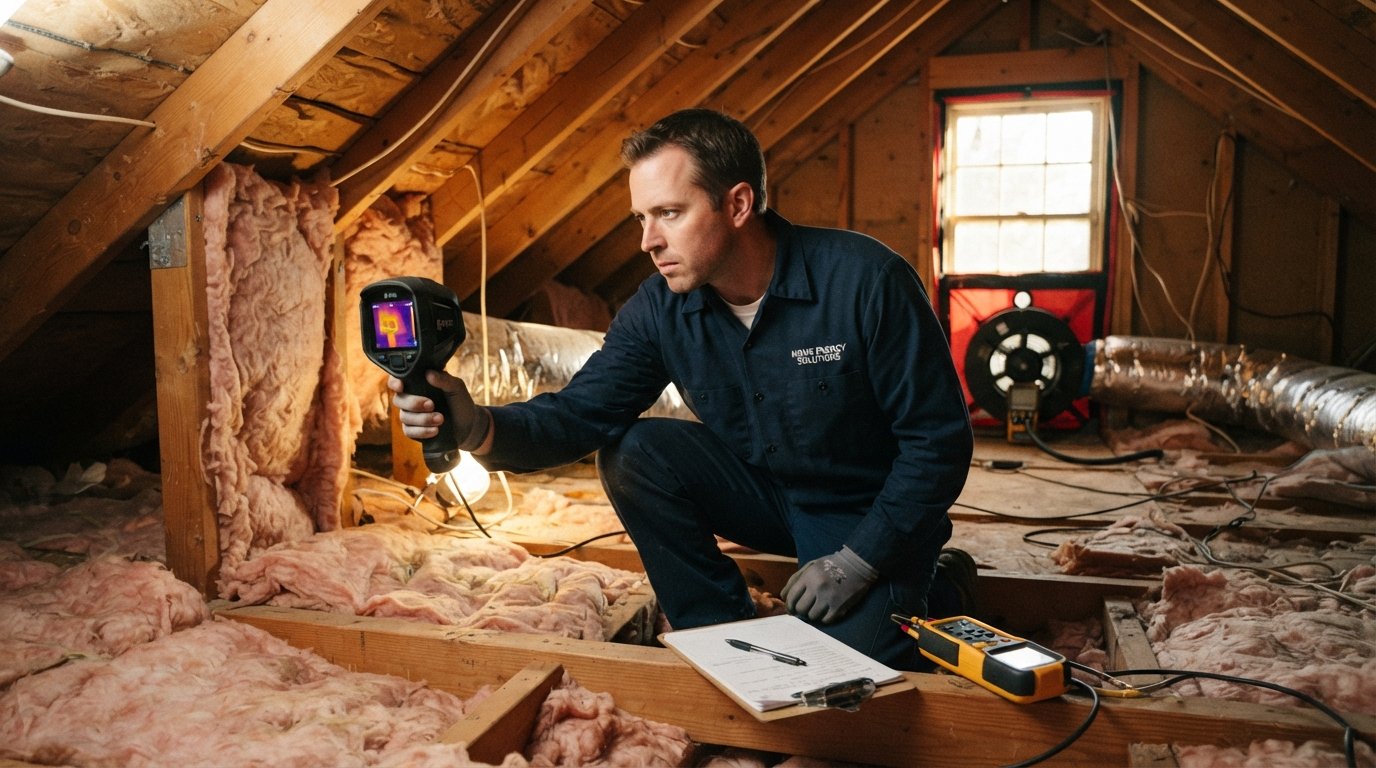
Before you replace a furnace or order new windows, you need data. A professional home energy audit typically costs between $200 and $500, though many utility companies offer them free or heavily subsidized. During the audit, a certified technician uses a blower door test, infrared camera, and duct pressure diagnostics to find exactly where your home loses energy. The report ranks improvements by cost, savings, and payback period, giving you a prioritized roadmap instead of guesswork.
Homeowners who skip the audit often overspend on visible upgrades like windows while ignoring cheap fixes like air sealing that deliver faster returns. For example, a $400 attic air-sealing job can cut heating costs by 10 to 20 percent, while $8,000 in replacement windows might save only 7 to 15 percent. The audit tells you which problem to solve first. If you need help finding a qualified auditor or a contractor to implement the recommendations, platforms like FreeQuotes.Contractors connect you with pre-vetted local pros who can handle everything from insulation to HVAC replacement.
Ranking Energy Upgrades by Payback Period
Payback period is the time it takes for your energy savings to equal your upfront cost. The shorter the payback, the better the ROI. Climate matters enormously: a homeowner in Phoenix will see different returns than one in Minneapolis. Still, national averages reveal a clear hierarchy. Below is a practical ranking of the most common upgrades, from fastest to slowest payback.
- Air sealing and weatherstripping: Payback of 1 to 3 years. Cost is low ($200 to $600), and savings are immediate.
- Attic insulation and duct sealing: Payback of 2 to 5 years. Blowing in insulation and sealing ducts can cut HVAC loads by 15 to 25 percent.
- Smart thermostats and HVAC tuning: Payback of 2 to 4 years. A $150 to $300 thermostat plus a professional tune-up often reduces heating and cooling bills by 8 to 12 percent.
- Heat pump HVAC replacement: Payback of 5 to 10 years. Higher upfront cost ($5,000 to $12,000) but dramatic efficiency gains, especially when replacing an old furnace or AC.
- Window replacement: Payback of 10 to 20 years. Energy savings alone rarely justify the cost, but windows add resale value and comfort.
- Solar panel installation: Payback of 6 to 12 years depending on state incentives and utility rates. After payback, electricity is nearly free for 15 to 20 years.
Notice that the cheapest upgrades often have the best ROI. That is why energy auditors consistently recommend sealing and insulating before replacing mechanical systems. However, payback period is not the only metric. Resale value, comfort, and resilience also matter. A home with a new heat pump and solar panels may sell faster and command a premium, even if the pure energy payback stretches beyond a decade.
Which Upgrades Qualify for Federal Tax Credits and Utility Rebates
The Inflation Reduction Act reshaped the incentive landscape for homeowners. As of 2026, several categories of upgrades qualify for federal tax credits worth 30 percent of the project cost, up to annual caps. Stacking these with utility rebates can reduce your net cost by 30 to 50 percent or more. Here is what to know.
- Heat pumps (HVAC and water heaters): 30 percent federal tax credit, up to $2,000 per year for heat pumps, plus additional rebates from many utilities.
- Insulation and air sealing: 30 percent credit, up to $1,200 per year. Often paired with local utility rebates that cover another 20 to 30 percent.
- Windows and skylights: 30 percent credit, up to $600 total. Must meet ENERGY STAR Most Efficient criteria.
- Solar panels and battery storage: 30 percent federal credit with no dollar cap. Battery storage also qualifies when installed with solar.
- Electrical panel upgrades: 30 percent credit, up to $600, when required for a qualifying heat pump or solar installation.
Utility rebates vary widely by state and even by zip code. Some utilities offer $500 for a smart thermostat, while others offer nothing. Before you sign a contract, check your utility's website and the Database of State Incentives for Renewables and Efficiency (DSIRE). A qualified contractor will often handle the paperwork for you, but you should always confirm the final net cost in writing. Never assume a rebate is guaranteed until the work is complete and inspected.
Sequencing Upgrades So One Project Does Not Undermine Another
Order matters. If you install a high-efficiency furnace before sealing your ducts, you waste money on a system that still loses 20 percent of its output to leaks. If you replace windows before adding insulation, you may still feel drafts from under-insulated walls. The correct sequence follows a simple principle: reduce the load first, then size the equipment.
Here is a proven order of operations for most homes:
- Air sealing and weatherization: Stop uncontrolled air movement through attics, basements, and crawl spaces.
- Insulation: Add attic, wall, and floor insulation to slow heat transfer.
- Duct sealing and balancing: Ensure conditioned air reaches rooms efficiently.
- HVAC replacement or tuning: Now that the load is lower, you can install a smaller, cheaper heat pump that runs less often.
- Windows and doors: Upgrade after the building envelope is tight, so you do not overspend on high-performance glazing to compensate for leaks.
- Solar and storage: Size the system based on your reduced electricity consumption, not your old wasteful usage.
Following this sequence can save you thousands. For instance, a homeowner who seals and insulates before buying a new heat pump might need a 2-ton unit instead of a 3-ton unit, saving $2,000 or more upfront and hundreds per year in operating costs. Similarly, solar arrays sized after efficiency upgrades cost less and pay back faster.
Windows, HVAC, and Solar: A Closer Look at ROI Nuances
Window replacement is the most misunderstood upgrade. Energy savings alone rarely justify the cost, but high-performance windows improve comfort, reduce outside noise, and eliminate fading of furniture. In extreme climates, the savings are higher. According to ENERGY STAR, replacing single-pane windows with ENERGY STAR certified models can save $101 to $583 per year in heating and cooling costs depending on climate. That still means a 15- to 25-year payback for a full-house replacement. However, if you are already replacing windows for aesthetic reasons or because they are broken, choosing energy-efficient models is a no-brainer. The incremental cost is small compared to the total project.
HVAC replacement is where ROI gets interesting. If your furnace or air conditioner is over 15 years old, it is likely operating at 60 to 70 percent efficiency. A new heat pump can achieve 300 to 400 percent efficiency (coefficient of performance) because it moves heat rather than generating it. The payback period is often 5 to 8 years when you factor in both energy savings and available tax credits. In addition, heat pumps provide both heating and cooling, eliminating the need for a separate furnace and AC. That simplifies maintenance and reduces long-term repair costs.
Solar panels have a longer payback but a massive long-term payoff. After the initial 6- to 12-year payback, you enjoy 15 to 20 years of nearly free electricity. If your utility offers net metering, you can sell excess power back to the grid. With battery storage, you can keep the lights on during outages and further reduce reliance on the grid. The 30 percent federal tax credit applies to both solar and batteries, and many states offer additional incentives. Solar also increases home value: studies from Zillow and Lawrence Berkeley National Laboratory show that solar homes sell for about 4 percent more than comparable non-solar homes.
How to Calculate Your Own ROI Before You Commit
You do not need a finance degree to estimate ROI. Start by gathering three numbers: the upfront cost after incentives, the annual energy savings, and the expected lifespan of the upgrade. Then use this simple formula: Payback Years = Net Cost / Annual Savings. For example, if attic insulation costs $1,500 after rebates and saves $300 per year, the payback is 5 years. If the insulation lasts 25 years, you get 20 years of pure savings.
For a more sophisticated view, consider the time value of money and rising utility rates. Energy prices have historically increased 2 to 4 percent per year. That means your savings grow over time. A upgrade with a 7-year simple payback might have an effective payback of 6 years when you account for rate increases. You can also factor in avoided maintenance costs. A new heat pump, for instance, may come with a 10-year parts warranty, reducing repair bills compared to an aging furnace.
Finally, think about non-financial returns. Comfort, indoor air quality, noise reduction, and resilience during extreme weather all add value that does not show up in a payback calculation. For many homeowners, these benefits justify upgrades even when the pure energy ROI is modest.
Where to Find Qualified Contractors and Maximize Your Savings
Even the best-planned upgrade fails if the installation is poor. Air sealing done wrong can trap moisture. A heat pump sized incorrectly will run constantly and wear out early. Solar panels installed on a shaded roof will underperform. That is why hiring a pre-vetted, licensed contractor is critical. Look for professionals who are certified by BPI (Building Performance Institute) or NATE (North American Technician Excellence) for HVAC work. For solar, check for NABCEP certification. These credentials signal that the contractor has passed rigorous testing and adheres to industry best practices.
When you request quotes, ask for a room-by-room load calculation (Manual J) for HVAC, a blower door test for insulation, and a shade analysis for solar. Reputable contractors will provide these without hesitation. Also confirm that they will handle rebate paperwork and that the quoted price reflects the final net cost after all incentives. If a contractor promises unrealistic savings or pressures you to sign immediately, walk away.
To simplify the process, use a platform that connects you with multiple pre-screened contractors in your area. You can compare bids side by side, check reviews, and verify licenses. This competitive process not only gives you better pricing but also helps you avoid scams. Many homeowners find that the lowest bid is not always the best value; a slightly higher quote from a certified installer often pays off through better performance and fewer headaches.
Making a Smart, Staged Plan for Your Home
You do not have to do everything at once. In fact, staging upgrades over two to three years can be financially smarter. Start with a home energy audit, then tackle air sealing and insulation. Use the savings from those low-cost improvements to help fund a heat pump or solar array later. Each step reduces your energy load, making the next upgrade cheaper and more effective. Keep records of every improvement, including receipts and contractor information. When you sell your home, you can document the upgrades and their energy savings, which can justify a higher asking price.
Remember that the best ROI comes from the upgrades that address your specific home's biggest weaknesses. A drafty 1950s ranch needs insulation and air sealing far more than it needs new windows. A newer home with tight construction might benefit most from a heat pump or solar. The only way to know for sure is to measure, prioritize, and hire qualified professionals who can execute the work correctly. With careful planning and the right incentives, you can cut your utility bills, increase your home's value, and enjoy a more comfortable living space for decades to come.